Hànzì Analyzer is a reference tool for those learning spoken and written Chinese. It presents all the characters you would find in a modern Chinese dictionary in a searchable and explorable fashion—providing various methods for looking up characters and making translations, and providing tables that convey statistical information about the language.
You can choose to work with simplified or traditional characters (both are always displayed for comparison purposes; everything's color-coded), and you can choose between Mandarin and Cantonese.
Hànzì Analyzer makes the entirety of the Chinese characters accessible to someone learning Chinese (such as myself). By accessible, I mean that I can find any character, either searching by sound (easier) or by radical (a bit harder). One of the best ways to build knowledge of Chinese is to look up characters. The more you search and explore, the more you will learn about strokes, radicals, and phonetic components.
I wrote Hànzì Analyzer for myself and hope that others may find it useful. It's the result of me pulling together various resources into a tool that helps me build my Chinese vocabulary and that enables me to use Chinese characters in my own documents. The resource I've depended on most is the Unihan Character Database made available by The Unicode Consortium.
I wrote this in 1997. To see what I worked on in 2011, see my Chinese Character Browser.
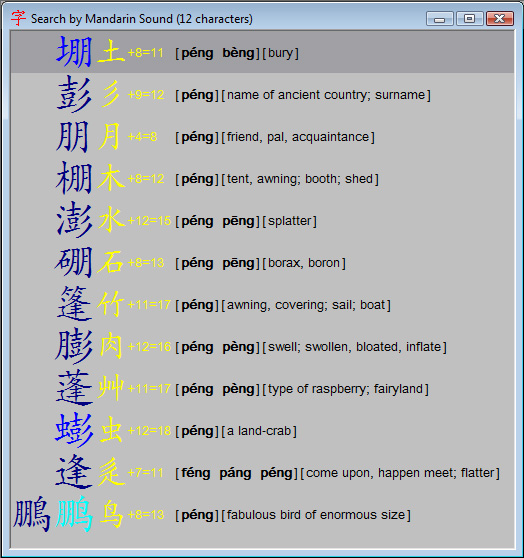
Hànzì Analyzer was designed to display Chinese characters in a very large font, so you needn't strain your eyes trying to become familiar with the various strokes and how they're used, and also so you can appreciate and learn the appearance of the characters. The font point size is customizable, as is the font used. By default, a character is displayed along with its radical, stroke count, pronunciations, and a rudimentary definition. For example:
You can copy-and-paste from Hànzì Analyzer into a word processor, making it a kind of input-method editor (IME) that lets you search by radical and stroke count.
If you’re looking for a particular Chinese character, you can search by sound or by various combinations of radicals and stroke counts.
You can translate English words into Chinese terms.
You can translate Chinese terms into English by supplying their romanizations, with or without a pitch indication. For example, typing dian hua (searching in Mandarin) will find telephone.
Note: The dictionary feature is rather clunky and not very useful (it doesn't know about neutral tones; see ahead). Rather than disabling it, I just leave it enabled. It comes in handy now and then.
Hànzì Analyzer offers an array of statistical analysis tools. Perhaps you’d like to know which sound is the most common sound (from a dictionary standpoint, not a usage standpoint). Perhaps you’d like to know which stroke count is most common. Perhaps you’d like to know which sounds are used with the most number of pitch inflections. A number of interactive tables are available that let you explore this kind of information.
As this has all been eked out in my spare time, it contains some inelegancies. Perhaps the most important hint I can offer is: Click on a character with the second mouse button to get to some of the most useful features.
An existing strong interest in (and some experience with) the Chinese language is assumed. Also assumed is knowledge of the following:
Sorry—there's no installation program. To get up and running, simply download this ZIP file and run the executable.
Feel free to send feedback to "feedback @ hemiola.com". Wondering what a hemiola is? Click here for a definition.
Copyright © 1997-2014 by Jens-Ingo Farley